

You've carved out an hour. You are here to actually make some progress on your music.
You sit down to produce. But instead of finishing something, you watch a YouTube video on a new compression technique. You open three projects and listen back. You tweak a hi-hat, fatten up the bass (again), scroll through presets and swap out one EQ for another. The hour passes and you close your laptop. Another music session, zero progress.
We've all been there.
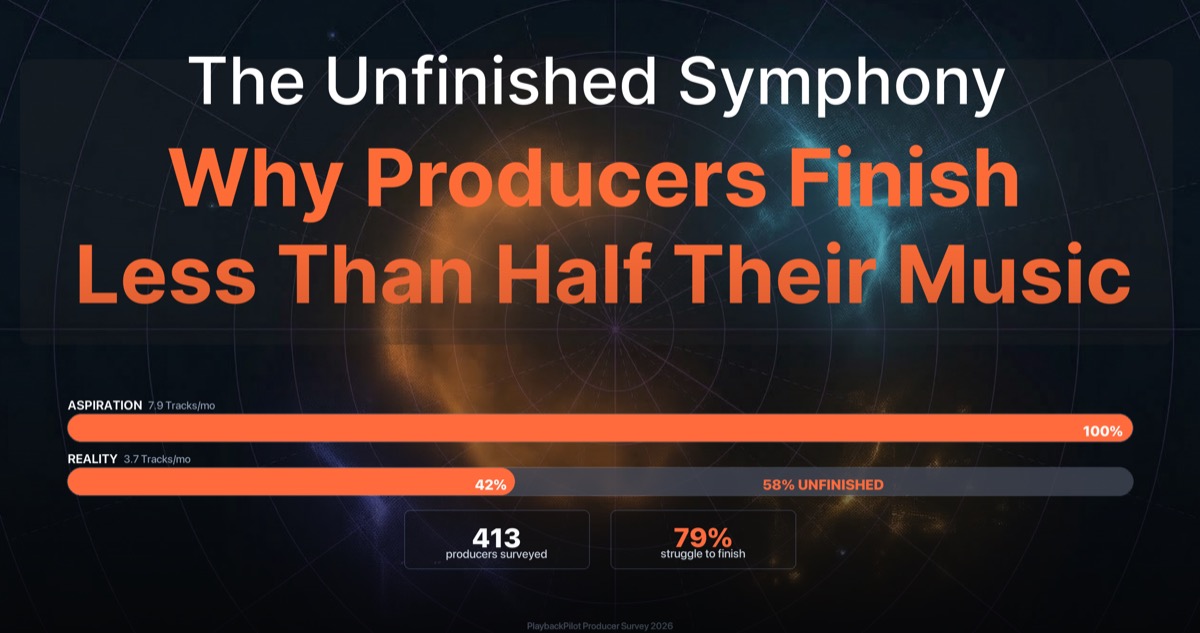
In Part 1 of this series, we shared the headline numbers from surveying 413 music producers: 79% of producers struggle with finishing, the average producer achieves only 42% of their monthly production goals, and 73% of them blame themselves for it.
Let me repeat that: three out of four producers attribute their lack of forward momentum to something internal to them.
So what are producers actually doing about it? How are they getting unstuck and breaking through these internal factors? What are their "secret" techniques and "quiet" workarounds that keep them moving forward, showing up and doing the creative act?
When I re-read the bottleneck responses and reflected on the conversations and email exchanges I've had with music producers these past months, I realized something: most of these producers have also quietly figured out small ways to move forward. They are not completely stuck. They are still trying. They are showing up. They are overcoming.
Like other artists, music makers are breaking through. They're inventing systems. Setting rules for themselves. Building spreadsheets. Color-coding folders. Forcing constraints. The struggle is real, but so is the work people are doing to get through it.
The struggle is universal. So are the small systems producers build for themselves when no tool helps.
This post is about those quiet workarounds — what they look like, who's using them, and why the producers who find their way through aren't using a magic method or workflow. They're inventing constraints, rituals, and small systems for themselves. And ultimately they are showing up, even when they feel resistance, discomfort and uncertainty.
Creatively productive producers find workarounds and ways of making progress and reaching the finish line on their creative goals. Let's dig into patterns blocking producers, how they navigate, and their workarounds to moving forward.
From Stuck to Unstuck: Patterns and Workarounds
1. The 8-Bar Loop Trap
When we reviewed our music producers survey and clustered 329 free text, bottleneck responses by theme, the single biggest pattern was the loop trap. Also known as "loop-itus", it is when a producer gets stuck polishing, tweaking, or overlistening to a single 4- or 8-bar loop and never expands it into a full arrangement.
The pattern was bigger than perfectionism, bigger than mixing, bigger than time. Here's what producers said:
- "Getting stuck in 8 bar loops, trying to do too much... not being able to settle on a sound direction"
- "I spend too much time listening to one loop and get bored of it and then I just abandon the project"
- "End up solely with loops"
- "Starting with a great idea, losing impetus by spending too long on one part"
- "Getting stuck with knowing what to add to finish the beat"
The loop trap is structural. A 4- or 8-bar loop is small enough to feel complete. You got something going but it's not a song. It's in limbo. You've now reached an impasse and the only way forward is to commit and make some decisions: arrangement, transitions, drops, breakdowns, another voice, etc. You can only move it forward with a commitment, but committing to a full song feels scary and uncertain. So you don't do anything. No render. Just a loop in your DAW. A retreat into the magic of the loop.
How do producers mentally frame the loop trap?
The strongest pattern I observed from alpha-tester conversations isn't a single trick. It's an assortment of techniques based on a core mental shift: reduce the size and scope of the next step until it's hard not to start. Cut your goal in half. Shrink what "progress" means right now to a single, stupidly simple next step.
In the case of the loop trap, add a creative constraint that forces you past the comfort of the loop and closer to a version of "done" for that stage.
Honestly, finishing an entire track in a single session is too big and too ambiguous to push against. It's not a task list item or a TODO; it's a multiple-step project. You need something small and doable now.
Producers who escape the loop trap aren't working harder — they're making the next step smaller, sharper, and more fun.
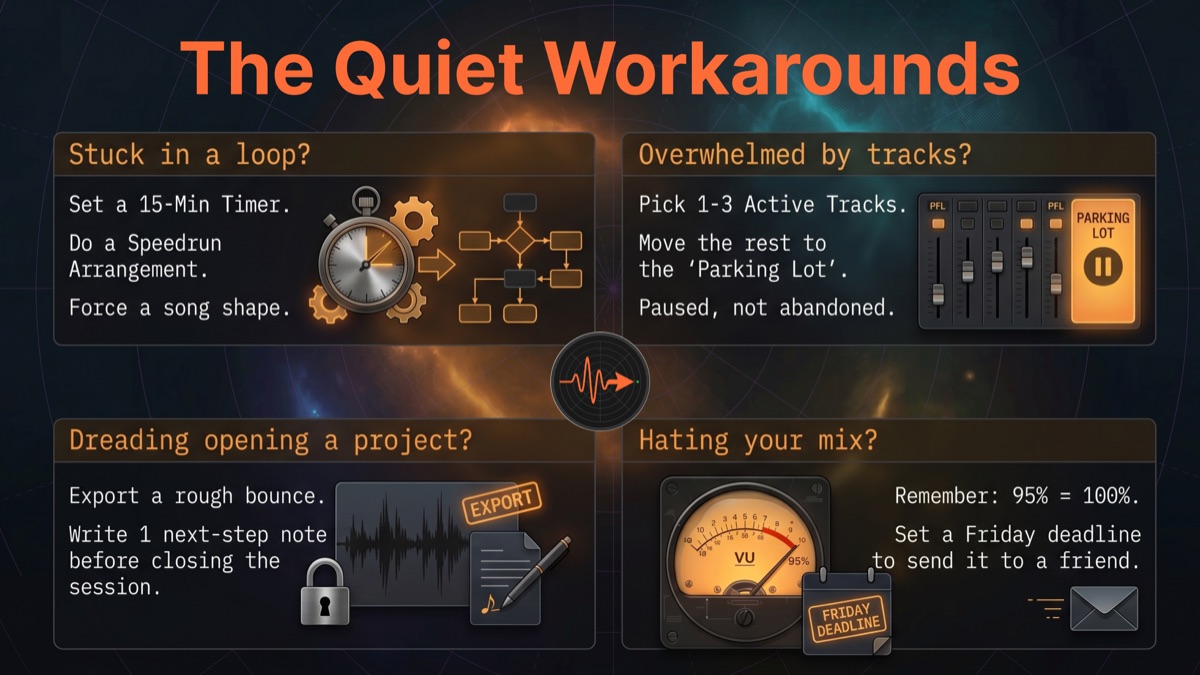
Workaround: The Speedrun Constraint
1. Set a timer (the universal creative constraint)
Whether it's music, writing, or most creative challenges, one of the oldest and most effective techniques to breaking through a creative block is to start a timer and work on that thing. The problem isn't time, it's infinite time. A short deadline and a dedicated block of time forces a decision and forward move. Even if it doesn't "work," a wrong-and-moving step beats perfect-and-stuck forever feeling.
I tend to use either a 20- or 30-minute timer for most getting started or I'm-not-sure creative blockers. But the "set a timer" rule of thumb can be scaled and adjusted to the size of the task: 10 minutes on one sound, 15 on an arrangement section, 30 on a key-and-tempo commitment. You might also elect to take a 2 hour studio session, do pomodoros, and spend 20 minutes on 3-4 tracks with 10 minute breaks.
2. The Speedrun Arrangement (Pheek).
Producer and mastering engineer Jean-Patrice Rémillard (Pheek) has a named 15-minute version of the timer move: the Speedrun Arrangement. Set a 15-minute timer, copy your loop across a full 3-minute track structure, move elements around instinctively. Don't worry about transitions yet. In Pheek's words: "the speed forces you out of perfection mode and into playful discovery."
The point isn't that 15 minutes is enough. It's that the timer forces song-shaped decisions you'd otherwise avoid. Once you have a shape, you can refine it. You can't refine what never got built.
Whatever you call it (Speedrun Arrangement, one-pass mix, 10-min of preset tweaking, Oblique Strategies), these short forcing function moves compress decision making into a process that carries you past your specific stuck point.
3. Training the muscle of quick creative choices.
As music makers we know tons of techniques, often from excessive YouTube watching, but struggle to know when and where to apply those skills and techniques. We overthink and can't move forward. The two moves we discussed above are tactical and particularly useful when you're stuck on a particular stage or gap. But a deeper workaround is building the underlying skill or muscle they all rely on: the ability to make quick creative decisions without agonizing. This is a rep-based skill you can develop through deliberate practice.
Years ago, after finishing my first EP, I realized something obvious: the best way to get better at music production was simply doing the process end to end over and over. You can't get better at a skill without reps. So I ran an experiment on myself: 30 songs in 30 days. One track per day, end to end.
The constraint meant I couldn't loop-polish. I had to move through every stage of songwriting and production in a single sitting to reach a 1-2 minute song, not just a 15-20 second loop.
A day or two before starting I scribbled a list of genres, synths and VSTs I wanted to try and explore. Then each day after my day job and some exercise, I'd open up my DAW, select an option (or roll the dice) and just get started.
After the first couple sessions, I realized it was mostly about cultivating a spirit of play and fun. There is magic in discovering an intriguing sound, catchy melody or chord progression and then moving on. Once you capture the creative core of a song, it started to feel like I just had to let myself be pulled, not overthink and to add other complementary sonic elements piece by piece, bird by bird. Each session ended with a new demo or rough draft song that I dropped into my main audio player. Progress was visible.
But what I noticed after about a week wasn't just that I was finishing consistently. It was that I was deciding faster. I was making quick instinctive calls about arrangement, sound selection, and rough mixing. By not having infinite time to decide nor the pressure of the "right call," I could just decide.
By day 30, I was also slightly better at my DAW, I had found my own step-by-step semi-structured song production process and my confidence had improved. By tackling genres and VSTs I'd never tried and applying techniques I only knew in theory, I had a better sense of what tools I had in my toolkit too. The biggest benefit was becoming a faster decider and cultivating the muscle of quick creative decisions, a muscle that didn't disappear when the experiment ended.
One thing to try: Next session, pick ONE creative decision you've been avoiding — an arrangement choice, a sound commitment, a section you haven't started. Set a 15-minute timer. Make a move. Make a decision before it runs out. No wrong moves. The point is to move.
2. Too Many Ideas, No System
A smaller percentage of survey responses, but some of the longest and most emotionally intense ones. These aren't stuck producers. They're prolific producers who can't manage their own output.
- "What bothers me the most is starting way too many projects at one time causing me to feel overwhelmed."
- "Ideas come so fast that I don't have time to complete one before the next idea has manifested"
- "I spend too much time jumping between projects and there isn't an intuitive platform to help with lyrics and melody creation simultaneously."
- "Staying organized in an intuitive way. I use my iPhone all the time. Then there's Logic, and voice memos, scattered ideas I end up working on multiple songs but only get a little bit done"
When everything feels equally important — or equally unfinished — you default to whatever feels freshest or keep starting new loops. Sadly, this means the older stuff never gets iterated on or done.
How do producers think about having too many unfinished projects?
Every active yet unfinished track is a tab open in your brain. You might not be thinking about it all the time, but uncompleted tasks pull at our attention and quietly drain our energy. The more active and unfinished projects sitting in your folders, the heavier the invisible load. Ironically, finishing 30 songs in 30 days led me to a version of this. I now had even more work-in-progress, unfinished, unreleased tracks than before.
Productively successful creative producers aren't trying to finish everything all at once. They are managing the pile of unfinished tracks by sorting and prioritizing. They're picking a small active set to focus on and finish.
Whether they make it explicit or not, they are also mentally shifting everything else as not now. These tracks are not necessarily abandoned; they are paused. For me, I call this the "parking lot," which is where I park tracks that aren't actively being worked on but available for future engagement.
Workaround: The Parking Lot System
1. Name your active set. One of my testers described the shift mid-email: "If a track is paused it's good to recognize that. It could remove some of the guilt by being realistic about where a project is. Ideally I would only have a few songs in the active bin." The practical move for most producers is to consciously name 1-3 tracks as active right now.
2. Own and rank your priorities before you open the DAW. Another producer described his approach: "My focus is on this one track first, then an EP/album project, followed by another EP project." He literally ranks his projects before opening anything. When he sits down, the "what should I work on?" decision is already made. The order is the system.
3. Park for Later. By picking your active set and ranking your priorities, you've implicitly decided what you're not working on right now. The third move is making that explicit — giving everything else a named status rather than letting it sit in guilty limbo.
I call mine the "parking lot": a place for tracks that aren't dead, just waiting. Being okay with sitting on dozens or even hundreds of unfinished tracks is hard. It can feel like abandonment. But paused is a status; abandoned is a verdict. Same track, different word, different feeling. A parking lot gives you permission to focus on your active set without guilt about the rest. It also means those tracks are still there when you're ready, not lost in a folder of unnamed projects you'll never reopen.
I originally managed this mental gymnastics of a focus list and parking lot using a simple music tracking spreadsheet. Over time, it has evolved into Playback Pilot's track status system and the Vault.
One thing to try: Name your three active projects this week. Write them down. Everything else is explicitly paused — not abandoned, not forgotten, just not now. Notice what changes when the pile has a shape and what to focus on has already been decided.
3. Losing Your Place Between Sessions
This is a quiet, deceptive pattern. It often hides under the word "time."
- "I never have time to finish what I start and end up losing progress"
- "When I do find a block of time to set aside for a project, I waste too much time trying to find most recent saves."
- "Knowing what sort of track is in each vaguely titled project. Feel, tempo, key, instrumentation, what's missing"
The word "time" appears 45 times in 329 responses. But reading the surrounding sentences and "time" almost always indicates struggles with continuity. The producer isn't lacking hours. They're losing context between the hours they have already put in and the studio time they have before them.
Pretty much every music producer I've interacted with has a specific folder where they dump unfinished tracks and early drafts. They know it's there and have a vague feeling of its potential. But it's largely forgotten and nearly a graveyard, because for most, it is a folder you've stopped opening up and progress has stalled. As producers we often stop checking in on our projects to avoid the discomfort of seeing how much is unfinished, a phenomenon psychologists call the ostrich problem. This is something I've struggled with for years as my pile of song demos grows and my anxiety about how I'll finish them increases. I'm haunted by my "My Songs - In Progress" folder.
How do producers think about session re-entry?
Tracks don't languish simply from neglect; they languish due to session re-entry friction. You can't remember what's left to work on, where you left a track, or what the remaining moves are.
Workaround: The Breadcrumb Trail
1. Always end with a render. Before you close the DAW, bounce something — rough is fine. A rendered file is proof you were here. It's what future-you will listen to instead of reopening the project cold.
2. The session-end one-liner. A note tells you what you did and makes progress tangible. More importantly, it tells you where you were, what's next, and what was bothering you. The note closes a mental loop on that session and gives your next session an easier on-ramp. Don't start cold — start with a breadcrumb.
3. Rate Your Excitement. Even better, give the version you rendered a rating. I use a modified five-star system to indicate how excited I am with a track, plus a completion percentage (0 to 100). The combination of a rendered track, a note, and/or progress indicators helps me sort and prioritize what is closest to done or would most benefit from a dedicated session.
4. The Hard Reset + Morning Test. Producer Glenn MacRae recommends stopping a session at 90 or 95%, closing it, and waiting 24-48 hours before you relisten. Then listen once with fresh ears, write down your immediate impressions. Those become your compass heading and to-do list for one final pass.
One thing to try: At the end of your next session, before you close the DAW, do two things: export a rough bounce and write one line — where you left off, what's next, what's bugging you. Next time you sit down, read that line before you open the project. The difference between starting cold and starting with a breadcrumb is often the difference between a track that moves forward and one that stays in the graveyard.
4. The Self-Blame Whirlpool
Self-blame is the meta-pattern beneath all the other patterns. According to the survey and Part 1 blog post, 73% of producers blame their finishing bottlenecks on internal factors.
Here is how producers talked about this:
- "I actually find my creations not enough good to be finished"
- "Making final decisions to wrap up projects. Lately I tend to question myself and if the project is where it really should be."
- "Get distracted by trying to live up to my previous success."
- "Doing everything myself and trying to be perfect"
There are several different labels, behaviors and concepts interwoven with self-blame and various forms of our negative self-talk. Perfectionism was its most common manifestation in the dataset, and it is saying "this isn't done yet." Self-doubt was another, and while it looks at first glance like perfectionism, it's a darker and more sinister message. Self-doubt says "this isn't worth finishing" or worse yet "I am not worthy of being an artist."
I'd argue that self-blame creates a loop with a whirlpool effect: you don't finish → you feel bad about not finishing → you doubt whether you can finish → you give up or start something new to escape the feeling → you don't finish.
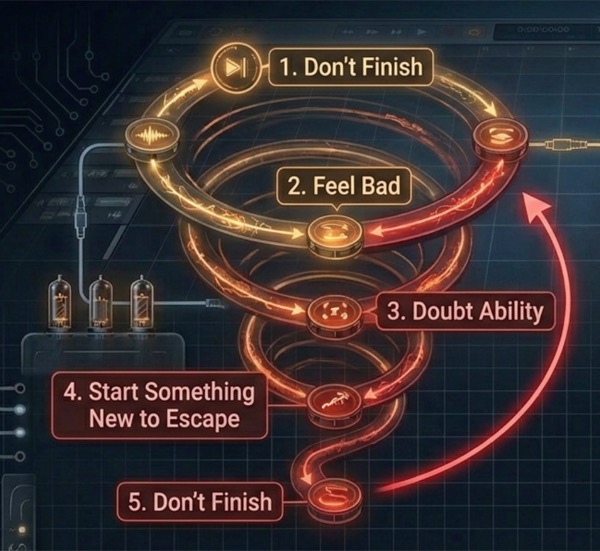
How do producers think about the self-blame whirlpool?
In Steven Pressfield's The War of Art, he identifies this inner force that opposes any creative act — especially the act of declaring something done — and calls it Resistance. Pressfield's reframe matters here: Resistance isn't evidence that you're broken or uniquely unsuited to making music. It's a predictable feature of doing creative work. Every producer who has ever shipped anything has had to fight it. Naming it — instead of treating it as a character flaw — already changes what you do about it.
Even though I've finished and released 6 albums, I still feel like each creative project comes with head winds that hinder me at certain points. Sometimes it's just the natural state of getting stuck in the middle. The end result is lost momentum, delayed progress, and negative self-talk.
Workaround: The External Forcing Function
1. Accept imperfect reality. Every track starts as a perfect fantasy in your head. The moment you execute, it becomes imperfect. That gap between vision and reality is where self-blame thrives. But the imperfections aren't failures — they're the personality of the track. Don't measure against the fantasy version or the professionally mastered tracks online. Measure against how far you've come. Glenn MacRae frames it cleanly: "If it's 95% good to you, it's 100% to the audience. The last 1% of quality takes 99% of the effort. Ignore it."
2. Keep a finished list. The inner critic says "you never finish anything." But most producers are already finishing more than they think. Keep a running list of what you've actually completed — released songs, tracks taken from demo to V2, even just tracks reviewed with notes. This list becomes your counter-evidence. The anchor point you use to remind yourself that you can make progress and you are a finisher.
3. Make it social — and give it a deadline. Music production used to be inherently social — studios, engineers, session musicians. Now you can do it all solo on a laptop, which is empowering but removes the built-in accountability that comes with other people waiting on your work. The workaround: put people back in the loop. Send a rough mix to a collaborator before it feels ready. Tell someone you'll have it by Friday. Record vocals, track an instrument or book a session with a mix engineer, even if the track is only 80% there.
And when social accountability isn't enough, formalize it and pick a date. A submission deadline for a sync library BEFORE your next vacation or a holiday. An artificial sprint rule: export latest version of track by day 14 or move on. External stakes, even just promising to send to a friend by a certain day, makes not-finishing more uncomfortable than finishing imperfectly. These kinds of shifts are often all it takes to break the whirlpool.
During my current album, I've used collaborators and accountability partners as forcing functions. I worked with my main writing and recording collaborator to go from a stalled start of demos to a tracklist and committed early versions with a better melodic core. I worked with a vocalist to give tracks a stronger identity, a hook and literally a voice. And when I was struggling on the mix stage, I hired a professional mixer to see if my production translated to their ears and get it more professional. Along the way I set deadlines too in order to ensure I was always moving forward on mini sprints and iterations that got me closer and closer to done and released.
One thing to try: Next time you catch yourself thinking "this isn't good enough" or "I should just start something new," pause. Notice it and reflect on it. That's one of your personal whirlpools starting to pull you and your track's momentum down. Then, instead of retreating or hiding, write it down word for word and ask yourself: Is it true? Can I fix it? Or is it just the discomfort of being almost done or one of your usual creative demons talking? Whatever you discover, you've uncovered something important — either about the track itself or about your own artistic DNA — and your next move will be a whole lot clearer.
What the Quiet Workarounds Have in Common
Every workaround in this post follows two core steps. First, notice — identify the specific pattern that has you stuck. Then, shrink your next move until acting on it is easier than avoiding it.
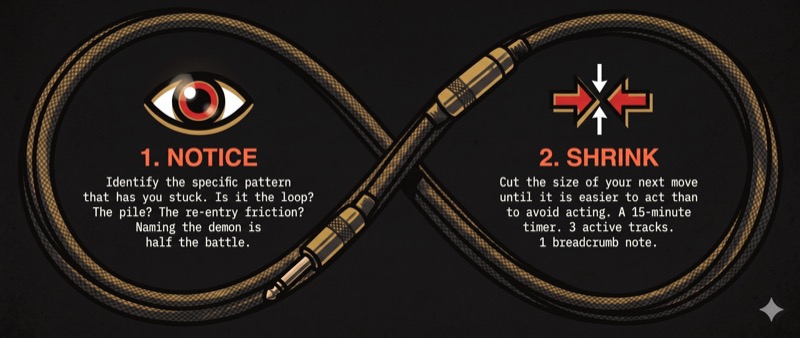
Stuck in a loop? Try The Speedrun Constraint — set a 15-minute timer and force a song-shaped decision. Drowning in projects? Build a Parking Lot — name your 3 active tracks and give everything else explicit permission to wait. Losing context between sessions? Leave a Breadcrumb Trail — one rough bounce and one line of notes before you close the DAW. Caught in the self-blame whirlpool? Set up an External Forcing Function — send a rough mix to someone, book a session, pick a deadline.
None of these are about having a better tool or a magic workflow. They're creative constraints, personal rituals, and small systems — built mostly outside of your DAW — that help you notice what's blocking you and move forward in spite of it. No software can completely remove the struggle to finish, because the finishing problem isn't a technology gap. It's the space between knowing what to do and actually doing it when you feel uncomfortable and uncertain.
The producers who make progress aren't necessarily more talented or more disciplined. They've simply built up a repertoire of workarounds that help them break out of the whirlpool and keep moving forward, one next move at a time.
Pick one. Try it this week. See what changes. Tell me how it goes.
Related: Part 1: Why Producers Finish Less Than Half Their Music | The Ostrich Problem | Cut Your Goal in Half | Stuck in the Middle
AIDA (AI Disclosure Acknowledgement): This blog post was researched and written by the author and is based on survey results and email and video call exchanges. AI tools (Claude Code) were used to assist with ideation, editing, structural organization, and overall clarity.
Related Posts
Producer Pipelines: How Working Producers Move Songs Forward
A working pipeline isn't a list of stages — it's a system for movement. Four producer profiles reveal the onramps, offramps, and decision rules that keep songs moving forward.
The Unfinished Symphony: Why Producers Finish Less Than Half Their Music
We surveyed 413 music producers and found a 58% gap between the tracks they want to finish and what they actually ship. Here's what the data — and their own words — reveal about why finishing is so hard.
See PlaybackPilot in Action — Album Management Walkthrough
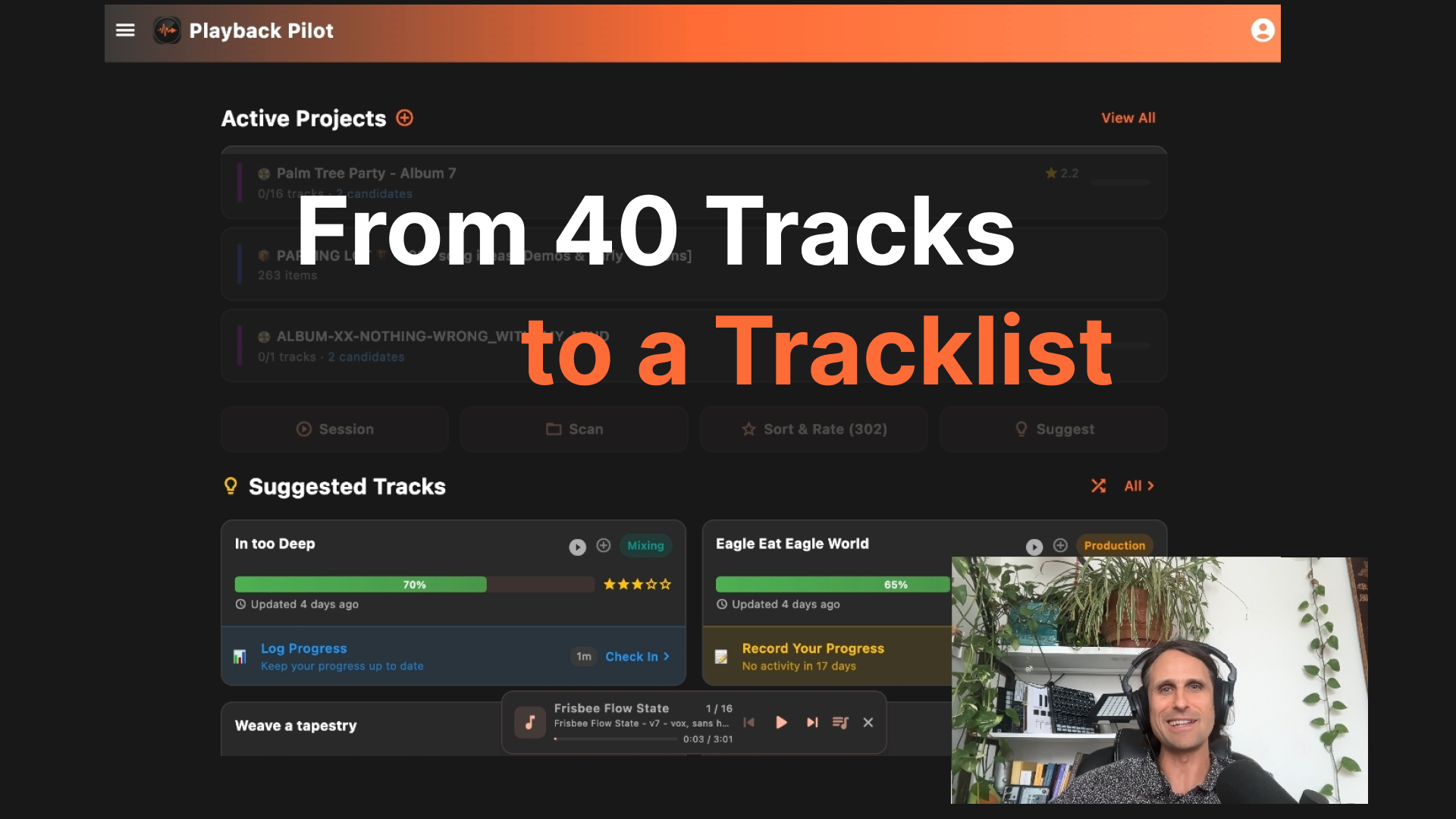
A 3-minute walkthrough of how I'm using PlaybackPilot to manage my 7th album release — from 40+ Ableton projects to a finished tracklist.