

What's your onramp into the next stage of your music project? And what's the detour that keeps pulling you off?
Lack of a studio and tools no longer blocks us from making great-sounding songs. The modern laptop replaced the million-dollar studio. Affordable DAWs, plugin suites, and sample libraries have democratized the core toolkit of music production. The gear is no longer the bottleneck. Almost anyone with a bedroom can now make a song that sounds good.
So what's actually slowing us down? The workflow. The decision rules that move tracks forward. And the discipline of staying organized.
The organizational layer and operational frameworks are what separate organized pros from stuck-in-the-middle music producers and endless starters. Your producer pipeline is whatever workflow you define and use that gets a song from idea to finished.
More precisely, a working pipeline isn't really a list of stages. It's a system designed for movement — onramps that pull you into the next stage, offramps that push you out of the current one. Underneath every producer pipeline are structural questions: not just 'what are the stages,' but 'what's the onramp that pulls me into the next one?' and 'what's the offramp out of the current one?'
Standard Music Industry Workflow: Built for Teams, Not Solo Producers
Most producers learn some version of the standard music industry workflow, a traditional 5-phase model that has been taught for decades:
Composition → Arrangement → Sound Design / Production → Mixing → Mastering
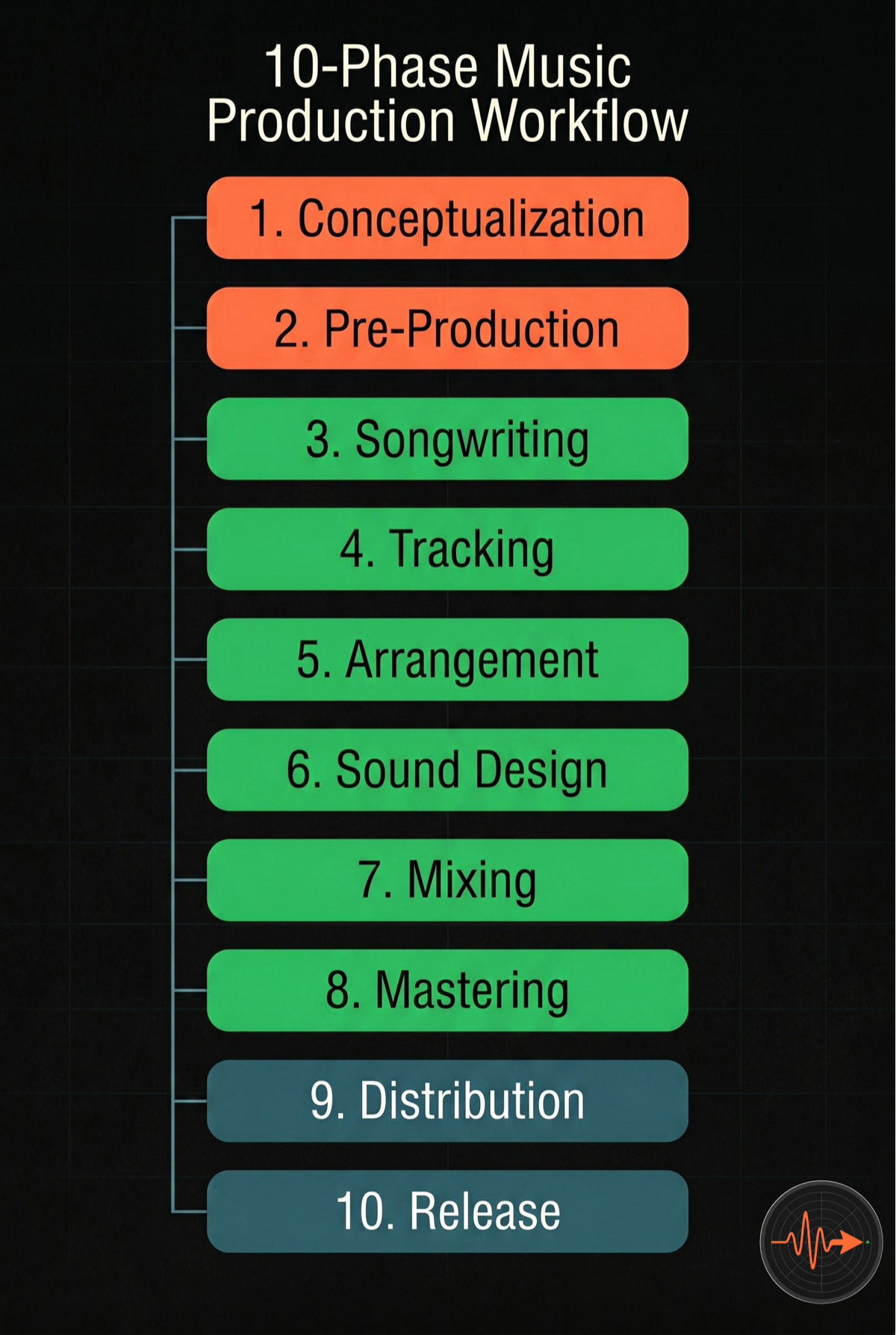
A more comprehensive 10-phase model adds pre-production at the front and a post-production tail (distribution, marketing, release) at the back:
1. Conceptualization → 2. Pre-Production → 3. Songwriting / Composition → 4. Recording / Tracking → 5. Arrangement → 6. Sound Design / Editing → 7. Mixing → 8. Mastering → 9. Distribution → 10. Release
But the stage count isn't the point. This model exists because traditional music production was multi-person. An artist or band wrote. A producer recorded. An engineer mixed. A mastering engineer mastered. Each stage had its own people, often its own room. The pipeline was as much about handoffs between specialists as it was about the music.
Bedroom and solo producers don't have that team. You're songwriter, producer, and audio and mastering engineer all at once. The discipline of the multi-person pipeline doesn't translate cleanly: stages blur because you can hold them all in your head and phases collapse and overlap. You get stuck at a detail or jump to the end. No one is holding you accountable. You aren't forced to hand off your work to someone else for the next stage. It's hard to know what's done and where to stop.
Interestingly, while modern producers obviously know the standard model, none of the producers I talked to and researched actually follow either the textbook 5-phase or the 10-phase pipelines. In fact, nearly every productive and organized pro I've interviewed has come up with their own variation. Through trial and error, they adapted, customized, and developed their own production pipeline.
What's your music production workflow? What stages help you go from idea to a polished and finished song? And how do you know when a stage is done?
Let's explore four producers and their workflows.
Instrumentool: The Pre-Decided Pipeline
Instrumentool is a prolific beat maker and creative entrepreneur with over 20 years of music production experience. Each week he is shipping sample-based beats from ideation to beat sales. What enables him to routinely move beats is a combination of organizational practices and a predictable schedule.
He uses a file naming and organization system based on Tiago Forte's PARA method. As he told me recently, "I use tags on macOS for quick sorting of stages and have the same stages and color code in PBP."
His workflow looks like this:
No Arrangement (quick skeletons, sample chops, etc.) → Arrangement Complete → Mix Prep → Mix In Progress → Review → Sold → Not Using
Notably this isn't purely a production pipeline. As a beat seller, his pipeline extends beyond making the beat to what happens to it afterwards. Specifically, he has added two stages, Stage 6 Sold and Stage 7 Not Using — for commercial outcomes. For a producer whose creative work is also a product he is selling, that's a useful and empowering addition. It creates a natural pull to finish, so he can sell it.
How does he move through these stages? Instrumentool has formulated a strong deciding move:
I have a hard rule of advancing a beat to the next stage each time it's opened. That helps make decisions quicker.
Let's pause on this killer move. Instead of struggling to decide if and when something is good or done, he has already put a precommitment in place to move the track forward on every contact. He limits the number of revisions too. So, now opening a beat IS the trigger; advancing it IS the action. Fewer decisions, more doing. And the end result is a process of perpetual forward momentum.
But how does he know when he is done?
I know when a stage is done once I don't want/need to do anything else.
No checklist. No quality threshold. No reference track A/B-ing. The stage is done when you don't have a next move on it. When you're working through dozens of tracks, this is a killer minimalist exit criterion.
Instrumentool's "advance each open" rule is a simple and immediate onramp formula that can work for any level of music producer. Once you've settled on what stage a track is at, each session should be iterating it forward towards finishing what's called for at that stage. Don't overthink. Don't waste time on elaborate rubrics or random advice on YouTube. Just show up and commit to making the called-for moves to advance it forward. Once it's done, take the offramp and move the track on to its next phase and keep going.
Michael D: The Emergent Pipeline
While Instrumentool is an archetype of the organized pro, most producers aren't that organized — in their file systems or in their workflows. Michael D messaged me and described some of those gaps, including file organization:
I'm not too sure how many [tracks I have]. There are certain doubles I have of projects because I learned too late that Logic Pro (the DAW I use) has project alternatives.
A lot of us can relate. Not knowing our track count, forgetting what's in-progress, being unsure what stage half our songs are in — that's the default state for most bedroom producers (myself included).
When I asked Michael how he thinks about stages, he broke it down like this:
I think sorta like the pieces. The riffs and one time things I come up with that get incorporated. Then demos, mix and then mastering. So I guess 4 separate things.
His four stages: Pieces → Demos → Mix → Mastering.
Most workflow models start at Demo or Composition; Michael gives himself a stage before. The Pieces stage is where everything pre-song lives — voice notes, loops, riffs, and sub-song fragments that don't deserve to be called a demo yet but might one day get incorporated into one. For someone who builds longer-form music by incorporating riffs over weeks or months, having a place to put those fragments is the difference between a system and a hard drive of orphans. You also end up with clearer delineation between an idea, a demo, and a mix — and that delineation is critical for any producer pipeline.
Admittedly, Michael's pipeline isn't very crisp and the stages aren't perfectly delineated. That's okay; it doesn't have to be. Your pipeline doesn't need to be a clean spreadsheet to be real and useful — it just has to be honest and accommodating to how you actually work. Michael has a four-stage mental model he can name on demand. That's better than the average bedroom producer who can't. Operationally, it lets him triage his pre-song fragments separately from the tracks he's actively finishing.
When you can articulate what stage a song is at and what's called for at each stage — even in an emergent, slightly messy way — then you have your own working producer pipeline. Michael's process and onramps aren't always obvious, signposted, or paved, but they're real. Pipelines don't have to be tidy to be real; onramps don't have to be marked to work. They just need to work and help you get where you want to go.
Pheek: The Two-Layer Pipeline
Pheek (Jean-Patrice) is a music producer, mastering engineer, and teacher based in Montreal. He's been making and teaching music for over two decades. His pipeline has five stages:
R&D → Hook → Mockup → Arrangement → Mixing
Pheek has several notable and unique stage names in his process. Like Michael's riff or fragments stage, he has some pre-song stages which are geared towards openness and discovery, not production. The R&D (Research and Development) stage hints at a more purely exploratory phase of music making involving playful sound design, melody and chord trial and error, or experimentation, while Hook leans into finding and nailing the catchiest and most memorable part of songwriting.
He's naming what most producers leave implicit — the messy, exploratory early-creative phase where you don't yet know what you're making. This matters because most workflow models treat early creativity as a precursor to "real" production. Pheek treats it as part of the work, though more open-ended and decision-gated. R&D might take a session; it might take several. But it ends when you find the hook.
Once you've found the hook, you've got an embryonic song and your producer pipeline can move forward accordingly. The hook becomes the seed for the mockup (which you might also call the demo). The mockup becomes the arrangement. Once you've nailed the arrangement, it's time to mix and so on. Each stage has a defined decision gate and an articulated offramp, and each song gets handed off to the next with a clear question: what do I need at this stage before I can start the next?
What's also distinctive about Pheek's pipeline is how well it complements a host of techniques he and other producers use to avoid getting stuck. For example, Pheek's stage system pairs with his Speedrun Arrangement tactic — the 15-minute timer technique to break out of the 8-bar loop and sketch out a full song without overthinking. You can find a host of other techniques in Part 2 (Quiet Workarounds).
We often associate creativity with a messy process, but as veteran music producer and audio engineer Pheek shows, you can make room for both the messy, open discovery process and an enabling stage-by-stage approach to your producer pipeline. In fact, I argue that your strategy layer (the pipeline) works best in tandem with your tactical layers, like decision gates and Speedrun. The stage tells you what move comes next. The tactic invites the next move to make. Most producers have one or the other; Pheek has both.
Brian Eno: The Anti-Pipeline
Brian Eno — founding member of Roxy Music, innovator of ambient music, and producer of Bowie, U2, Talking Heads, and Coldplay — is the limit case. He doesn't follow a pipeline; he intervenes in one. "As a producer, I'm an interventionist," he's said. The session, in his frame, isn't a sequence to execute but a system to perturb — a canvas, a terrain for happy accidents. His Oblique Strategies cards ("honor thy error as a hidden intention," "use an old idea") exist to break the pipeline's trajectory on purpose — to provoke slight movement opportunities when the obvious next step won't come. Sometimes the best move forward is an anti-pipeline and a stageless stage.
Build Your Own Pipeline: Just Keep Going
Detours, delays, and getting stuck in the middle of a project or goal are entirely normal. Nearly every music producer gets stuck at some step in the creative journey. As our own 400+ producer survey revealed in Part 1, 79% of producers struggle to finish, and 73% blame themselves for it. The blocker isn't you, and you aren't broken. No one advances a piece of artwork through some standard pipeline without a certain amount of struggle and ambiguity, especially as a solo bedroom producer. The good news is that, amazingly, being stuck is rarely permanent, and producers have found dozens of quiet workarounds to keep moving anyway — timers, parking lots, breadcrumbs, forced deadlines, all of which we explored and cataloged in Part 2.
Underneath these four examples of producer pipelines (or anti-pipelines) are key patterns. None of these working producers follow the standard 5 or 10-stage pipeline. Each has found their own adaptations and variations. They've found their own stage names, clarified what each stage entails, and figured out decision points for movement and patient progress. While the pipelines look different, the underlying structural questions don't.
Most stuck producers aren't stuck at what should I do? They're stuck at what's my next move? Onramp or offramp. Languishing in uncertainty instead of doing without judgment. Am I in a detour of uncertainty, or failure to move at all? Is the track calling at me for an onramp or an offramp?
What every working pipeline in this piece quietly does is translate an open question into a decided action: advance each open, give fragments a place to live, find the hook before you arrange.
Your producer pipeline isn't there to be perfect. It's there to keep you moving. Slow productivity, not no productivity. Create or adapt a new stage if you're struggling. Or try a stageless stage, in Eno's framing, when nothing else moves. Just keep going.
When you sit down to work on a track, ask yourself: what's my onramp into the stage I'm in? How do I know when to take the offramp into the next one? And what's the signpost calling for a track to be done for now?
Related Posts
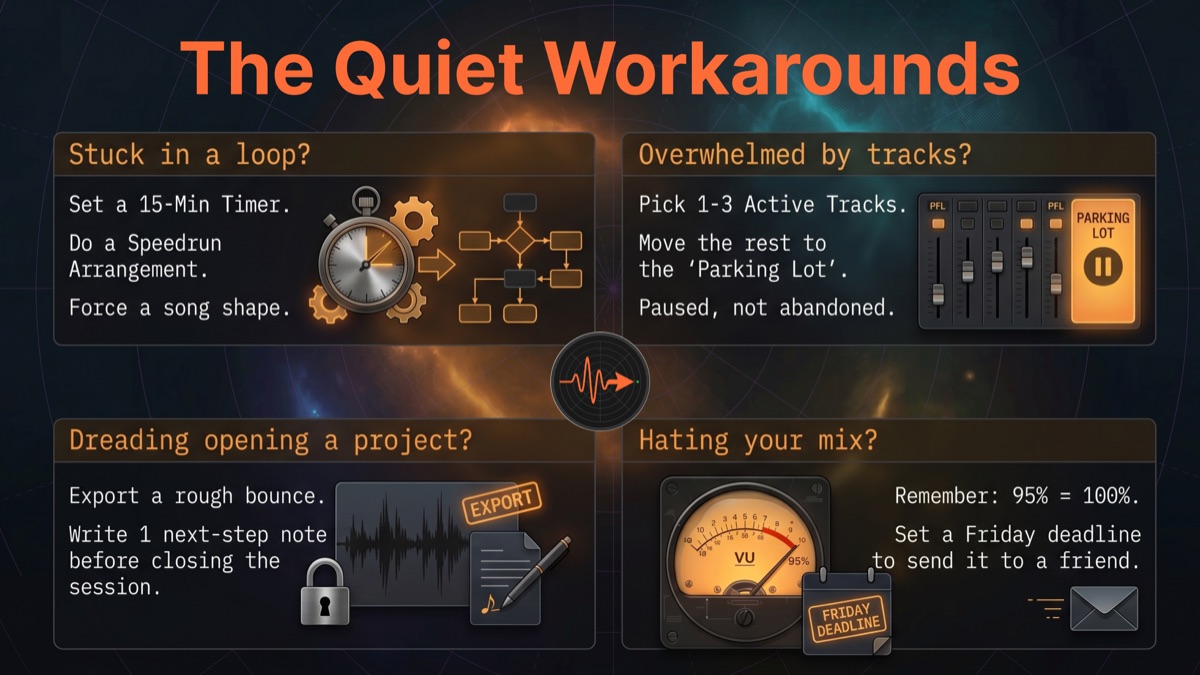
The Quiet Workarounds: What Producers Are Doing to Finish More Music
Producers aren't waiting for a magic workflow. They're setting timers, parking tracks, leaving breadcrumbs, and forcing deadlines. From 400+ survey responses and months of conversations, here are the patterns that keep tracks unfinished — and the quiet workarounds producers have figured out to move forward.
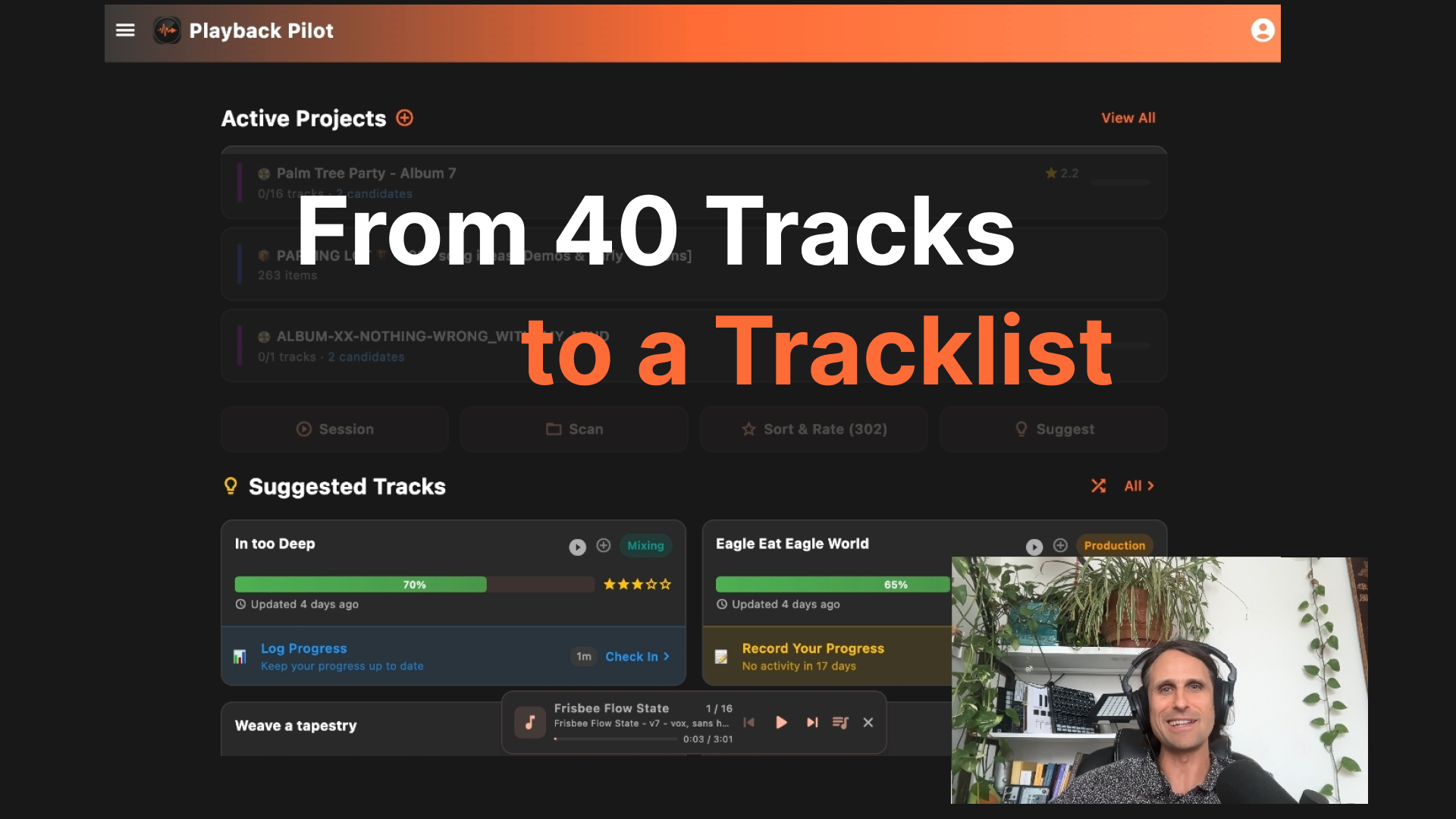
See PlaybackPilot in Action — Album Management Walkthrough
A 3-minute walkthrough of how I'm using PlaybackPilot to manage my 7th album release — from 40+ Ableton projects to a finished tracklist.
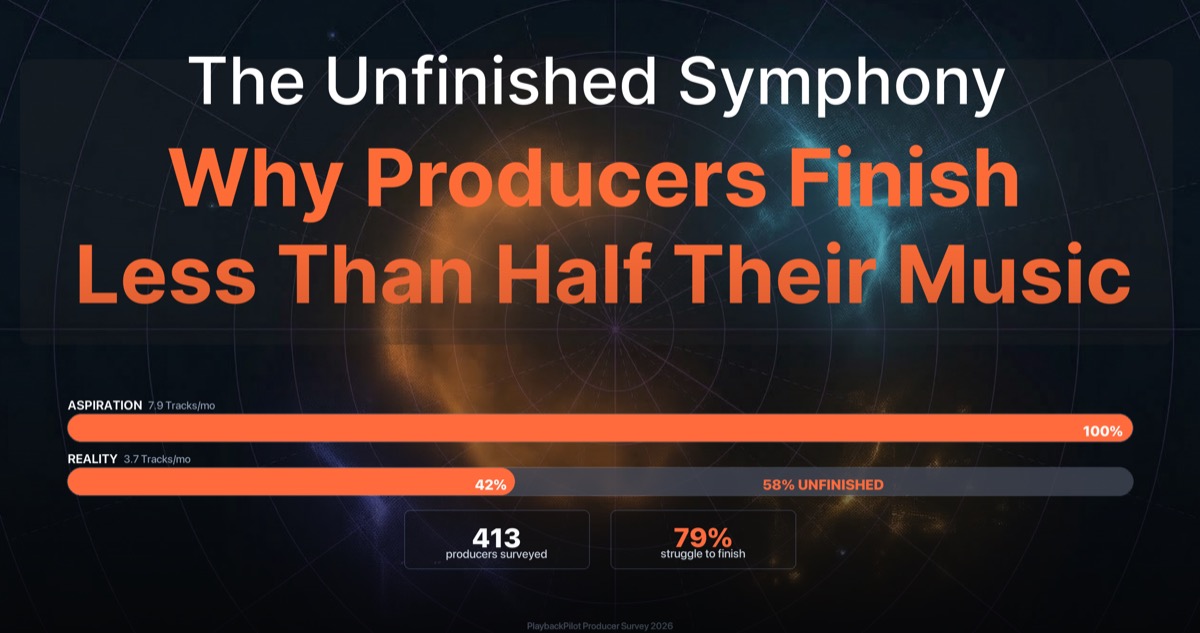
The Unfinished Symphony: Why Producers Finish Less Than Half Their Music
We surveyed 413 music producers and found a 58% gap between the tracks they want to finish and what they actually ship. Here's what the data — and their own words — reveal about why finishing is so hard.